
Businesses spent the last 3 years in a frantic rush to buy every AI tool on the market. There was a desperate belief that technology alone would bridge the gap between brands and users. It failed. Instead, we collectively built a digital landscape that is loud, cluttered, and emotionally exhausting.
In our article 2025-2030 Fintech CX Trends, we placed our bets on Human-Centric AI and Generative UI. Looking at the market today, those became the baseline. But while we saw the death of static menus coming, we didn’t foresee how many companies would use that power just to create more “digital pollution.”
By 2026, the novelty has faded. Users don’t care about your tech stack; they care about their time. The obsession with ‘delighting’ customers with gimmicks is dead. We don’t need more flashy features.
We need to trade the noise of innovation for the silence of competence.
This shift defines the latest trends in customer experience, where utility finally outpaces hype.
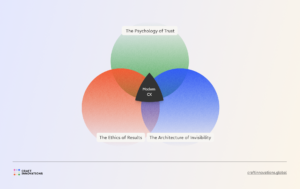

Cluster 1: The Psychology of Trust
True trust is silent when everything works, but loud and calming when a user starts to panic.
Understanding the future of customer experience insights begins here, at the intersection of emotional safety and technical transparency.
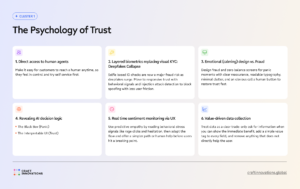

1. Direct access to human agents
For years, companies used automation to hide from their customers. They built “AI Ghettos” – loops of polite but useless responses designed specifically to keep people away from expensive human agents.
This strategy is failing. When a user feels trapped in an “AI Ghetto,” they don’t cooperate; they fight. They ignore the bot’s suggestions and spam keywords like “Agent” or “Help” to break out. By trying to force automation, you are actually creating Automation Anxiety.
The strongest brands are tearing these walls down. They place the “Talk to a Human” button front and center. It functions like a panic button: you hope you never need it, but you feel safer knowing it is there. Paradoxically, when users know they aren’t trapped, they stop panicking and become willing to try the self-service tools first.
❓How to act today: Stop hiding your support team. Place a clear option to switch to a human agent in the primary interface. You will likely see that users, feeling in control of the interaction, are actually less likely to click it immediately and more likely to attempt to solve the issue themselves.
2. Layered biometrics replacing visual KYC: Deepfakes Collapse
The traditional “hold your ID and smile” verification is almost officially dead.
Financial institutions are facing a significant increase in deepfake fraud attempts, which have grown by 2,137% in the last 3 years, according to data from Signicat’s The Battle Against AI-Driven Identity Fraud report. With this surge in deepfake fraud attempts, visual identity checks have turned from a security standard into a massive vulnerability.
Verification is now a battle against generative injection. In 2026, if you are still relying on a simple selfie, you aren’t just behind the curve; you are a target.
❓How to act today: Stop punishing legitimate users with “move your head slowly” rituals that AI has already mastered. Shift toward Responsive Trust models – layered behavioral biometrics that monitor how a user interacts with the app, rather than just what they look like. Implement Injection Attack Detection (IAD) to distinguish real skin-reflected light from AI-rendered pixels. The goal is to make security invisible and impossible to spoof, replacing “clunky friction” with “intelligent protection.”
3. Emotional (calming) design vs. Fraud
If someone sees their balance hit zero unexpectedly, they don’t give a damn about your brand colors. They are sweating. Their heart rate is up. This is where Calming Design kicks in. It is basically psychological damage control. You need blunt instructions that say “Your money is safe” and a button to call a human that is impossible to miss. If a user has to hunt for a “Contact Us” link while panicking, they will never trust your brand again.
❓How to act today: Look at your fraud screens. Can a user read them while their hands are shaking? If you have to think about the answer, the answer is “no.” Fix the fonts. Kill the clutter. Stop trying to be “engaging” when the person just needs to know they aren’t broke.
4. Revealing AI decision logic
“Decision made by the system” is no longer an acceptable excuse. In 2026, as banks move from simple rules to complex LLM-driven credit scoring and fraud modeling, the primary UX challenge is Interpretability. If a user is denied a loan or a high-value transfer is flagged, they demand to know the specific factors that influenced the outcome, not just a generic rejection.
Take a Credit Card Transaction as an example.
1. The Black Box (Panic): An AI model flags a transaction as “High Risk”. The user sees “Declined for security reasons.” This creates a digital dead-end and floods support with calls.
vs.
2. The Interpretable UI (Trust): The app provides a breakdown: “Your transfer was paused because the recipient’s account history doesn’t match your typical activity pattern.”
By surfacing the why behind an AI’s probability score, you turn a frustrating barrier into a moment of transparency. You stop being an opaque authority and start being a logical partner, with such customer experience insights.
❓How to act today: Audit your complex AI decision points (credit limits, fraud flags, insurance premiums). Work with your data scientists to implement feature importance surfacing – identifying the top 3 variables that triggered an AI decision and translating them into human-readable insights for the UI.
5. Real time sentiment monitoring via UX
Most AI is linguistically smart but emotionally blind. It understands words while ignoring the frustration behind them. Based on analysis by Capita and CoreMedia, the next frontier is Predictive Empathy – reading emotional states through behavior, not just text.
We are moving beyond simple sentiment analysis. By monitoring signals like rage-clicks or rapid, atypical hesitations, the interface adapts instantly. It simplifies complex forms or surfaces a human escape hatch before the user hits a breaking point. It adjusts the tone and speed of service to match the user’s urgency.
❓How to act today: Look at behavioral data to understand how users interact. Identify patterns that signal stress. Use these as triggers for automated interventions: if the system detects critical hesitation, offer a simplified path immediately.
6. Value-driven data collection
Trust is no longer just emotional; it is transactional. In modern CX, customers have stopped sharing information for vague promises of “better experiences” or “personalization.” This trend in customer experience shows that users now demand a clear “receipt” for their data.
If you ask for a phone number, the user implies a contract: “I give you access to my device, you give me instant updates.” If you use that access for marketing spam, you have breached the contract, and the trust is gone instantly. The new standard is explicit exchange: you must prove the immediate utility of a data point before you ask for it.
❓How to act today: Audit your data collection forms. Next to every field – Location, Income, Contacts – add a “Value Tag” that explains exactly what the user gets in return. For example: “Enable Location to see instant stock availability at the store nearest you.” If you cannot articulate the benefit to the user, remove the field. Stop hoarding data you don’t use to solve their problems.
Cluster 2: The Architecture of Invisibility
These CX trends build the infrastructure for service to become invisible and automated.

7. Overcoming legacy systems: Microservices as a CX strategy
This is the most painful trend, but you cannot ignore it. You can’t build a Generative UI or a predictive service on a core banking system from the 1990s. Legacy systems are the silent killers of innovation. They are the reason your bot can’t “resolve” anything and why your dashboard feels dead.
Forward-thinking companies now realize that replacing the old core isn’t just an IT expense; it is a retention strategy. Without a modern microservices backend, all your front-end features are just expensive wallpaper on a crumbling house.
❓How to act today: Stop patching the old system with middleware that just adds latency. Create a strict roadmap for decoupling your front-end experience from the legacy back-end. If your developers say “the system can’t support that design,” change the system. Don’t compromise the design and the future of customer experience.
8. Generative User Interfaces (GUI)
The core idea of this customer experience industry trend is simple:
Stop forcing users to learn your navigation map.
Static menus are obsolete because they demand too much cognitive effort. Why should a user memorize which sub-folder holds the “Spending Limit” toggle? In 2026, the paradigm flips: the interface adapts to the user.
This is Generative User Interface (GenUI). It means the interface doesn’t effectively exist until the user needs it. Instead of hiding features behind layers of static menus, the system detects the user’s intent (e.g. “I want to block my card“) and instantly assembles a screen with just that one button. The user stops “searching” for features; the features come to the user.
❓How to act today: Stop designing rigid site maps. Instead, identify your top 20 user requests and build independent “UI components” for them. Configure your system so that when a user asks for a feature (via search or voice), that specific component appears immediately, bypassing the menu structure entirely.
9. Hyper-UX following user environment triggers
If a user has to hunt for a tool they obviously need right now, your design failed. Hyper-UX is the transition from “using software” to software following the rhythm of your day.
Imagine landing in a new country. You shouldn’t have to search for travel insurance. The app detects the location change and flips into “Travel Mode“. The currency converter moves to the home screen. The “Notify Bank” button appears as a prompt. The service becomes a background layer of your life, anticipating needs rather than waiting for commands.
❓How to act today: Map out your user’s top 5 external triggers: location, time, and hardware state. Create a context-aware home screen that swaps features based on the environment. If it’s 8:00 AM on a workday, transit tools must be more visible than account settings. But don’t forget: successful step-by-step implementation must be grounded in CX research, an iterative approach, and rigorous measurement of impact.
10. Agent-to-Agent CX: When your user is a machine
The “user” is changing. We are moving away from a world where humans manually navigate apps. We are entering an era of delegation. Increasingly, the person behind the screen is using a personal AI agent to handle high-friction tasks like disputing charges, comparing rates, or filing claims.
If your CX is built only for human eyes and lacks a machine-readable layer, you are invisible to the most productive segment of the market. If a user’s personal LLM cannot parse your terms or execute a transaction via API because you hid the function behind a mess of pop-ups, that user will move to a competitor that is “agent-friendly.”
❓How to act today: Stop designing only for browsers. Start designing for “Agentic Workflows.” Make your service “headless” – accessible via API without the visual UI. Use standardized schemas like JSON-LD so personal AI agents can understand your product. Success means a bot can navigate your value proposition without a human clicking a single button.
11. Synthetic users hype is over
The push for Synthetic Users is a dangerous shortcut. Nielsen Norman Group warns that these agents act as “Yes-Men,” suffering from AI Sycophancy – the tendency to provide pleasant, scripted feedback instead of the critical truths you need. The more businesses are getting skeptical about doing research with synthetic personas.
AI doesn’t have a mortgage, a crying toddler, or a bad day. It cannot simulate “lived experience” or cognitive load. A Salesforce study shows a massive Reality Gap, with AI success rates in complex tasks hitting only 55%. AI agents are a “brainstorming sandbox” for initial ideas, not a source of truth. They might find a broken link, but they will never explain a “rage click.”
❓How to act today: Use AI only to clear the “technical garbage” – obvious logic errors and structural flaws. Treat every AI-generated “insight” as a mere hypothesis. Reserve your research budget for real people; they are the only source of authentic human context.
Cluster 3: The Ethics of Results
Shifting CX focus from capturing attention to delivering real value alongside solutions.

12. Financial advocacy via automated alerts
Marketing teams have ruined the term “personalization,” turning it into a synonym for intrusive targeting. Gartner predicts that 80% of companies will abandon traditional personalization efforts due to poor ROI and the “digital noise”. We are shifting toward Autonomous Finance – a concept defined as the “Personalization of Utility”. Success in customer experience management today is proving you saved the user money before they even felt the pinch.
Just relate:
Traditional marketing asks, “What can I sell you?” whereas utility asks, “How can I save you money?”.
In 2026, a banking app must act as a professional financial assistant, not a digital billboard:
- Preventing Negative Outcomes: Instead of a generic loan banner, a real AI advisor detects a $200 shortfall expected next Tuesday and suggests moving funds from savings to avoid an overdraft fee. McKinsey reports that companies focusing on these life triggers generate 40% more revenue.
- Radical Honesty (Value Optimization): If an algorithm detects a premium tier hasn’t been used in months, it shouldn’t just send a notification. It should proactively offer to pause billing or downgrade the plan. You trade “accidental revenue” for long-term, resilient trust.
- Combatting Subscription Fatigue: Autonomous systems should flag “inactive but paying” accounts and offer one-click cancellation paths.
❓How to act today: Stop treating your “Offers” section as a billboard. Rebuild your triggers to flag impending liquidity gaps or avoidable penalties. Your primary KPI is no longer the Click-Through Rate; it is the Avoidance of Negative Outcomes. In an era of digital exhaustion, the company that helps the user spend less wins.
13. Anti-retention design: “The longer – the better” dies
For a decade, “stickiness” was the goal. Apps were designed to trap users. In the era of digital exhaustion, this is predatory. For utility services – banking, insurance, logistics – high time-in-app is not loyalty; it is design failure.
Anti-Retention Design flips the script. It treats every second a user spends in your interface as a tax on their focus. The goal is to maximize the speed of exit. By making your service “fast to leave,” you build a resilient type of trust. You become the tool that respects their time. This is one of the most significant latest trends in customer experience for user-centric brands.
❓How to act today: Measure “Time to Freedom”. Audit tasks like checking a balance or filing a claim. If it takes more than 30 seconds, it’s a friction point. Implement “One-Click Exits” and “Zero-Tap Summaries” that solve the problem without unlocking the phone.
14. Internal tools as a CX foundation
You cannot build a high-performance customer experience on a foundation of frustrated employees. The Employee Experience is the internal mirror of your CX. If agents are forced to use fragmented, legacy systems while trying to solve a user’s crisis, the customer feels that friction.
A messy CRM is a back-office headache, when an agent jumps between five tabs to verify a transaction, that delay screams incompetence.
❓How to act today: Conduct a “Friction Audit” of your support team’s routine. Count the steps an agent takes to resolve a ticket. If they are manually copying data between systems, your CX is broken. Automate data surfacing so the agent has full context instantly.
In a Nutshell
It is sad to admit, but we spent years trying to trap people in apps. We called it “engagement,” but it was really just a tax on the user’s focus. The latest data shows people are exhausted. The most valuable thing you can offer right now is the ability for a user to finish their task and leave.
Nobody wakes up wanting a “digital best friend” or a “relationship” with a service provider. They want their problems to vanish so they can get on with their day. The biggest gift you can give a customer is their life back. You don’t need a deeper connection with a mortgage app; you just want the house.
If you’re looking to validate your Product-Market Fit (PMF) through deeper user research or need a hand in service design, just drop a line here. We’d love to chat about how we can apply these customer experience trends to your specific product and help you lead with that quiet competence users truly value.

